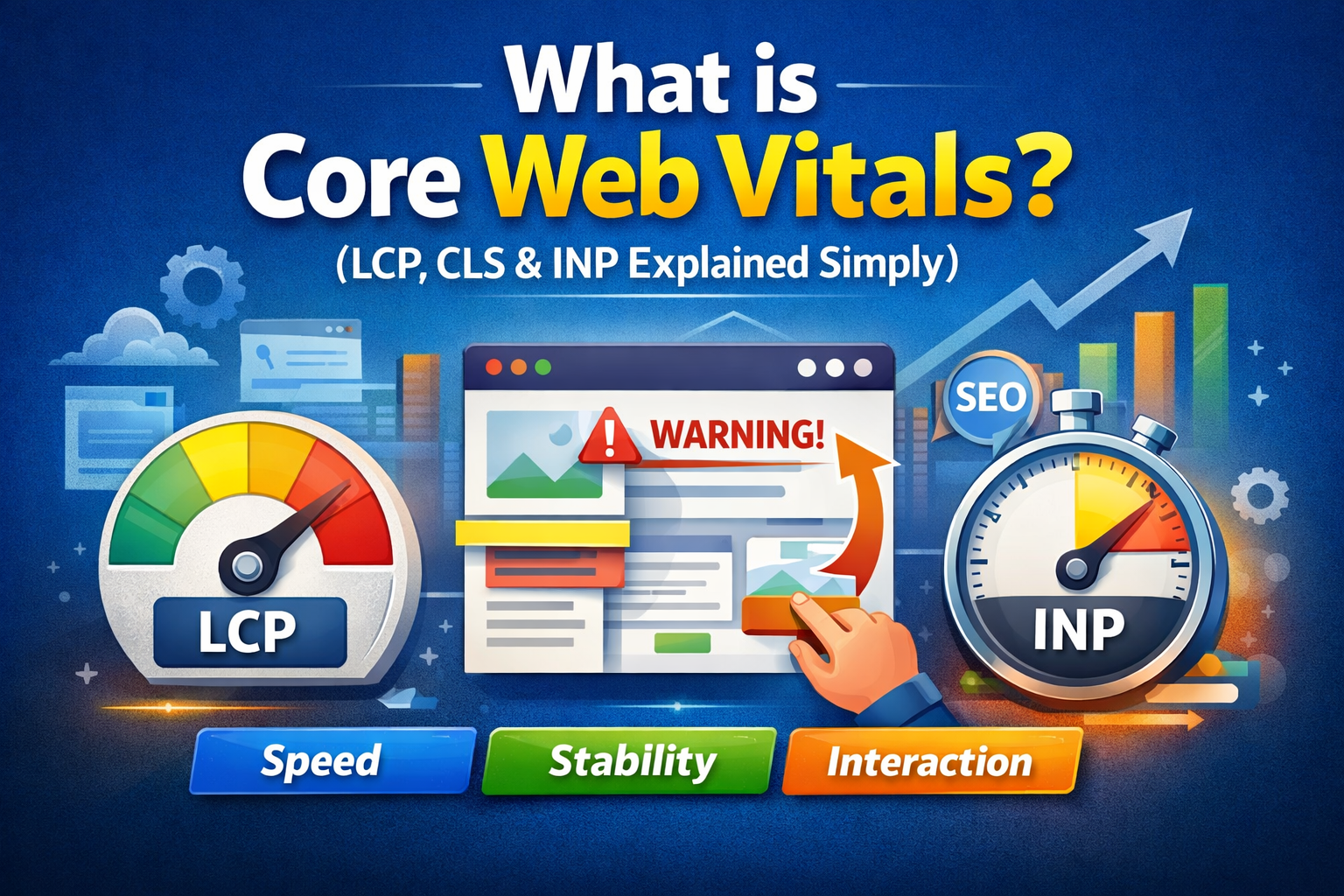
What is Core Web Vitals in 2026? Simple Guide to LCP, CLS and INP
If your website is not getting clicks, traffic, or rankings, there is a strong chance that your site speed and user experience (Core Web Vitals) are weak. This is where Core Web Vitals come in.
Core Web Vitals are a set of important signals that help Google understand how fast, stable, and smooth your website feels to users. In simple words, they measure how happy a visitor is when they open your site.
If a website opens fast, does not jump around, and responds quickly when you click, it is a good website.
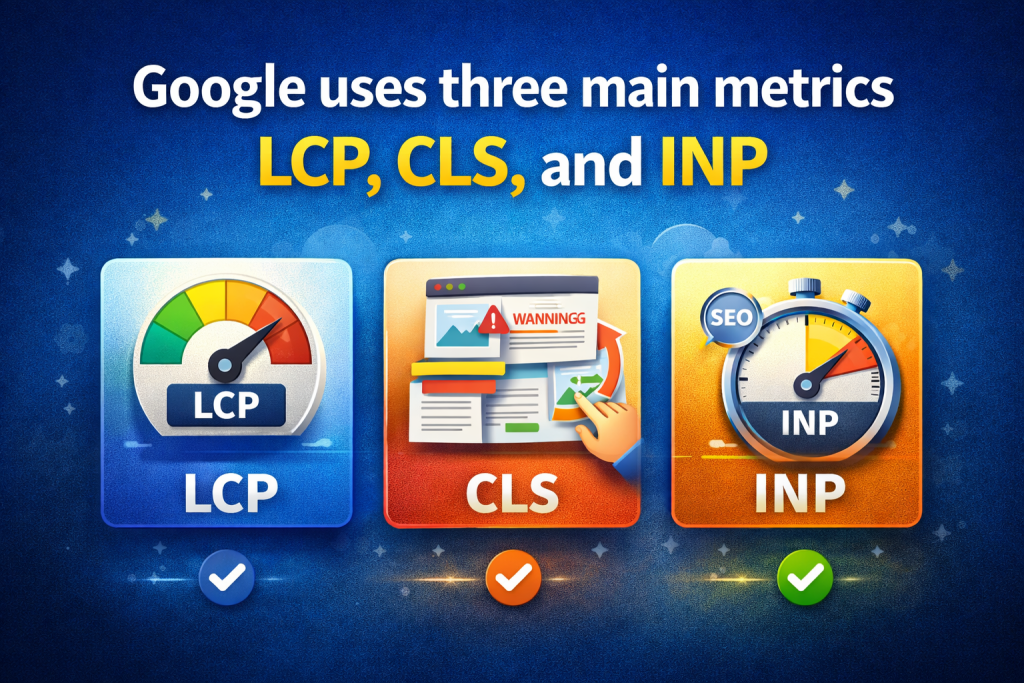
Let us understand each one in the simplest way.
What is LCP (Largest Contentful Paint)
LCP tells you how fast the main content of your page loads.
Imagine you open a website. You are waiting to see the main image or heading. The time it takes to show that main part is called LCP.
If it appears quickly, users feel happy. If it takes too long, users leave.
Good vs Bad LCP
| 0 to 2.5 seconds | Good | Page loads fast and users are happy |
| 2.5 to 4 seconds | Needs Improvement | A bit slow, may lose some users |
| More than 4 seconds | Poor | Very slow, users will leave |
Simple Example
If your homepage image takes 5 seconds to load, your LCP is poor.
How to Improve LCP
- Use smaller image sizes
- Choose fast hosting
- Remove unnecessary heavy elements
- Use caching
What is CLS (Cumulative Layout Shift)
CLS measures how stable your page is while loading.
Have you ever tried to click a button, and suddenly the page moves and you click something else? That is bad CLS.
CLS checks how much your page jumps or shifts.
Good vs Bad CLS
| CLS Score | Result | Meaning |
|---|---|---|
| 0 to 0.1 | Good | Page is stable |
| 0.1 to 0.25 | Needs Improvement | Slight movement |
| More than 0.25 | Poor | Page jumps too much |
Simple Example
You open a blog, and suddenly ads push the text down. That is bad CLS.
How to Improve CLS
- Always set image width and height
- Avoid sudden popups
- Use proper spacing for ads
- Load fonts properly
What is INP (Interaction to Next Paint)
INP measures how fast your website responds when a user clicks or taps.
If someone clicks a button, how quickly does your site react? That is INP.
A fast response feels smooth. A slow response feels frustrating.
Good vs Bad INP
| INP Score | Result | Meaning |
|---|---|---|
| Less than 200 milliseconds | Good | Very fast response |
| 200 to 500 milliseconds | Needs Improvement | Slight delay |
| More than 500 milliseconds | Poor | Slow and frustrating |
Simple Example
You click a menu, and it opens instantly. That is good INP.
If it takes time or freezes, that is bad INP.
How to Improve INP
- Reduce heavy JavaScript
- Use lightweight themes
- Improve server speed
- Avoid too many plugins
Why Core Web Vitals Are Important for SEO
Core Web Vitals are not just technical terms. They directly affect your rankings and traffic.
When your website is fast and smooth
- Users stay longer
- Bounce rate becomes low
- Google trusts your site more
When your website is slow
- Users leave quickly
- You lose clicks
- Rankings drop
So, improving Core Web Vitals means better SEO, more traffic, and more leads.
Easy Way to Remember
You can remember Core Web Vitals like this
- LCP means how fast your page shows
- CLS means how stable your page stays
- INP means how quickly your page reacts
Final Thoughts
Core Web Vitals may sound technical, but they are actually very simple. They are all about giving users a better experience.
If your website loads fast, stays stable, and responds quickly, you are already ahead of many competitors.
Start with small improvements. Fix images, reduce heavy code, and focus on speed. Over time, your rankings and traffic will improve.
If you want real growth from SEO, do not ignore Core Web Vitals. They are one of the strongest foundations of a successful website.
Frequently Asked Questions (FAQs)
1. Why is my website not getting traffic even after doing SEO?
This usually happens when your website is slow or not user-friendly. Even if you have done SEO, Google may not rank your site if users are not having a good experience. Improving Core Web Vitals can help you fix this and increase your chances of getting traffic.
2. How do I check my Core Web Vitals easily?
You can check your website performance using tools like Google PageSpeed Insights or Google Search Console. These tools will show you LCP, CLS, and INP scores along with suggestions to improve them.
3. Does website speed really affect Google rankings?
Yes, it does. Google wants to show fast and smooth websites to users. If your site is slow, users may leave quickly, and this can hurt your rankings. A faster website usually performs better in search results.
4. What is the fastest way to improve website speed?
The easiest way is to optimize your images, use a good hosting provider, and remove unnecessary plugins or heavy code. Even small improvements can make a big difference over time.
5. Why does my website move or jump while loading?
This happens because of poor layout stability (CLS). It usually occurs when images, ads, or fonts load without proper space. You can fix this by setting fixed sizes for images and avoiding sudden popups.
6. My website loads fast but still feels slow, why?
This is often due to poor interaction speed (INP). Even if your site looks fast, it may take time to respond when users click something. Reducing heavy JavaScript can help make your site feel faster.
7. Do Core Web Vitals matter for small websites or new blogs?
Yes, they matter for every website, even new ones. If you improve your site early, you can stay ahead of competitors and grow faster in search rankings.
8. Can I improve Core Web Vitals without coding skills?
Yes, you can. Many tools, themes, and plugins are available that help improve speed and performance without coding. You just need to choose lightweight options and avoid overloading your website.
9. How long does it take to see results after fixing Core Web Vitals?
It may take a few weeks for Google to notice improvements. But once your site becomes faster and smoother, you will start seeing better rankings, more clicks, and improved user engagement.
10. Is Core Web Vitals a one-time fix or ongoing work?
It is ongoing. As you add new content, images, or features, your performance can change. So it is important to keep checking and improving your website regularly.
👉 “Struggling with Core Web Vitals? Let Optizite fix your website speed and boost your rankings.”